Acrylic Paint Pens: Uses, Tips, and How to Choose the Right Set
Create vibrant artwork with acrylic paint pens that glide smoothly and dry fast. Perfect for canvas, rock painting, glass, wood, and everyday creative projects.

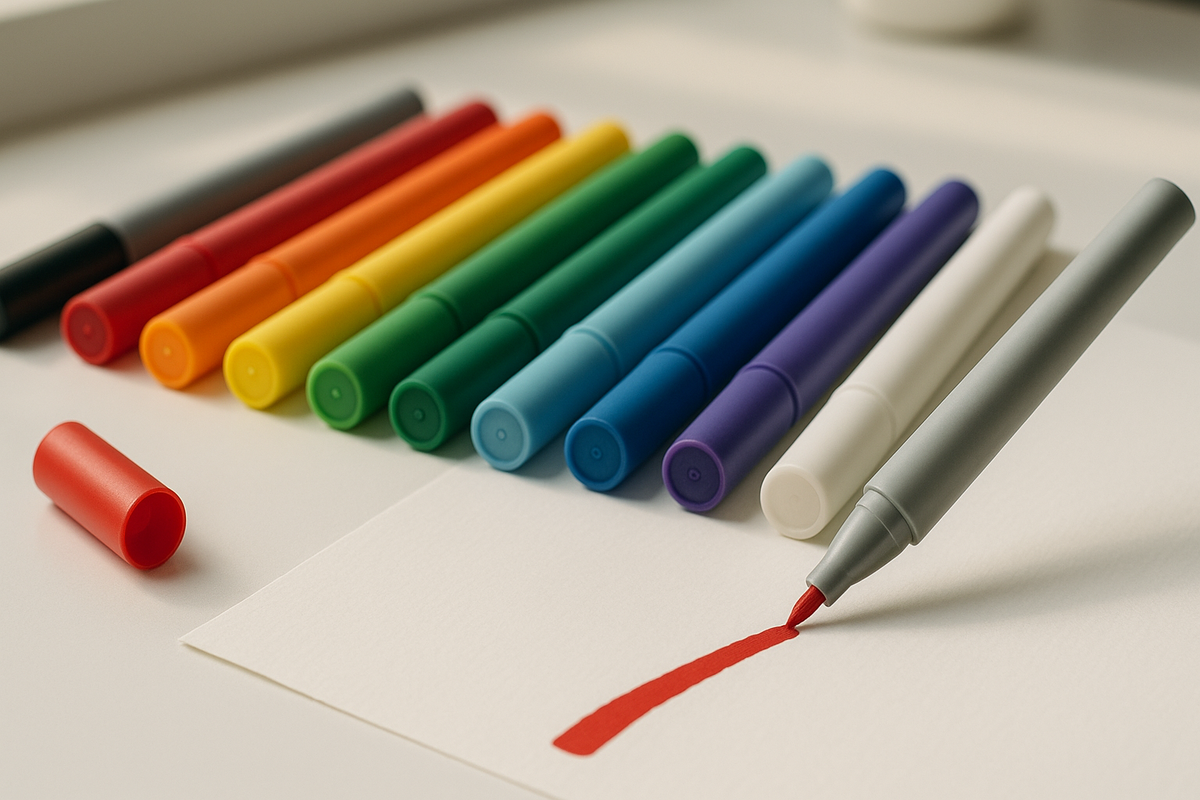
An Acrylic Paint Pen is an opaque acrylic paint in a small pen body, allowing controlled lines and high coverage on most artistic, decorative, and craft surfaces. This hybrid format integrates marker precision with a paint-like quality, allowing makers to experiment with sketching, writing, and object decoration without requiring complete traditional painting systems or the involved clean-up processes.
What Are Acrylic Paint Pens?
Acrylic Paint Pens are closed devices that contain fluid acrylic, which is transferred by valve-controlled nibs to make opaque lines and components on suitable surfaces. Each pen contains a small mixing ball containing pigment and binder, and the nib channel guides the flow of the mixture so that the dried layer is similar to thin, durable acrylic paint.
How Do Acrylic Paint Markers Work?
Acrylic paint markers use internal valves to deliver pigment from the reservoir to the nib in a steady, repeatable pattern. The sealed barrel protects texture, the ball keeps color mixed, and the nib slowly releases paint onto paper, wood, canvas, or other prepared materials.
How Are They Different from Permanent and Acrylic Brush Markers?
Differences between permanent markers and brush markers mainly involve opacity, surface behaviour, and the feel of each stroke across different materials. Dye-based permanent options often sink into fibres, brush versions give softer variation, while these acrylic tools form surface films with cleaner edges and stronger coverage.
What Can You Use Acrylic Paint Markers For?
Common Uses for Acrylic Paint Markers
Most applications include planner titles, rock patterns, greeting cards that need bright, opaque spots, signage details, and little decorative materials. Bright lines on top of stain or base coats are common with wooden ornaments, holiday decorations, and handmade tags, and acrylic marker pens are used as finishing touches.
Best Surfaces for Acrylic Paint Markers
The most appropriate surfaces for acrylic paint markers are paper, card, primed wood, canvas, stone, glass, metal, and a wide range of plastics that accept acrylic films.
Surfaces Where Acrylic Markers Don’t Work Well
Some surfaces are not compatible with such paints, especially waxed, oily, silicone-coated, or stretchy surfaces, which compromise bonding strength and long-term durability. The high-quality acrylic marker pens cannot be applied to wet colour due to their repulsion by both wax and grease.
How to Use Acrylic Paint Pens Properly?
The correct use of Acrylic Paint Pens is determined by the cleanliness of the surface, the consistency of flow, and the thin application of layers, as these three factors determine how clear, adhesive, and durable the paint will be.
Activate and Prime Acrylic Paint Markers
Initial activation of these markers involves moving pigment inside the barrel and letting the nib gradually saturate until strokes show solid colour.
Control Paint Flow and Line Quality
Flow and line quality control is tied to the nib firmness, the angle of contact, the pigment thickness, and surface smoothness, and they all collaborate on a single stroke. Stiffer nibs tend to produce smoother lines, shallow angles are more comfortable than vertical pressure, and most artists prefer acrylic marker pens for defining compact forms.
Prevent Peeling, Smudging, and Fading
On renewable surfaces moderately exposed to friction, sun, and water, smudging, peeling, and fading become less prevalent as the layers dry completely. Films are better adhered to thin deposits than to thick ones; they are easier to work on cleaner substrates, and closed pieces made with an Acrylic Paint Pen most often retain color strength over time.
What Tips Help You Get Better Results with These Markers?
Layering and Blending Tips
Blending and layering are most effective when the lines are drawn on a slightly sticky paint surface that allows the edges to blend rather than peeling the prior layers. Light values tend to be placed before them, more saturated ones come next, and on less textured papers, a handful of strokes on graded papers with acrylic marker pens may give a suggestion of gradient effects without blotting the color.
Tips for Fine Details and Lettering
Fine details and lettering rely upon fine nibs, fixed postures of the hands, and receptive surfaces on which small strokes are distinctly visible. Smooth card or Bristol minimizes feathering, pencil guides to spacing are sometimes used, and numerous calligraphic or comic styles use an Acrylic Paint Pen as an outline, as well as key structural lines.
Cleaning and Storage Tips
The cleaning and storage habits entail good practices: keeping the nibs dry and the barrels closed to maintain even moisture levels. Flow is disrupted by residue at the tip, horizontal storage tends to hold pigment more evenly, and well-closed systems of these markers tend to remain usable longer.
How to Choose the Right Acrylic Paint Pen Set?
You have to choose an Acrylic Paint Pen set depending on your regular surfaces, the level of detail required, the colours you use, and the magnitude of most of your work. Smaller collections in indispensable colours support sketchbooks and planners, and larger collections support murals and heavy craft, where coverage, opacity, and variety are more significant factors.
What Tip Size Should You Choose?
Selection of a tip size is associated with the favorite size of stroke, the size of the lettering, and the level of detail it can include within each area. Small nibs are used for the tiniest text, medium-sized ones for outlines, and weasel-sized nibs fill in faster, which is why many creators maintain a number of Acrylic Paint Pens of varying sizes simultaneously to maintain a flexible workflow.
What Paint Type Matters Most?
Other essential qualities of paint include opacity, viscosity, and lightfastness, as these determine handling and display life. Dark grounds are coped well with a high opaque colour, the heavier the mixture is, the more likely it will stand on a slippy surface, and the light pigments retain the colour under the room light or soft sunlight.
How Many Colors Do You Actually Need?
The quantity of useful colours depends more on palette style, variety of subjects, and the method of overlaying, rather than the possession of huge sets. A dozen carefully selected colours sustain numerous pages, increased assortments provide subtlety in portraits or landscapes, and several artists gradually switch the selections of acrylic marker pens with changing interests.
Acrylic Paint Markers for Different User Types
Best Choice for Beginners
In beginner sets, appropriate collections typically have modest colour selections, are well labelled, and have easy-to-touch barrels that are friendly at first. Mid-sized tips and balanced flow are used to write and fill, and an Acrylic Paint Pen can be useful to many users who are still learning to master gradual control and do not get frustrated when learning to control it.
Best Choice for Hobby Artists
For hobby artists, a good set of appealing sets might increase the strength of the set, the richness of the palette, and the variety of nib styles without superfluous complexity. Neutrals and bright accents support seasonal decor and home crafts; stable tips support relaxed sessions; and numerous casual creators use these markers to achieve quick yet colourful results.
Best Choice for Professional Artists
For professional artists, reliable sets usually feature lightfast pigments, replaceable nibs, and consistent, long-lasting flow. Works made in the gallery or printed art, or a before-and-after-a-clean-scan, many illustrators use Acrylic Paint Pen to paint only final outlines and finishing touches.
Conclusion
- The Acrylic Paint Pen offers opaque, controllable colour for use on most artistic and decorative surfaces.
- Surface preparation, tip size, and paint thickness have a significant impact on durability and visual clarity.
- Multiple layering techniques, minimal palettes, and proper storage patterns make collections of acrylic marker pens more versatile.
Frequently Asked Questions
Are Acrylic Paint Markers Waterproof When Dry?
The same brands can be waterproof on nonporous, clean surfaces, but prolonged exposure to a wet environment may dull brightness or edges over time. Obvious protective coatings make objects with high turnover more resilient.
Can These Markers Be Used on Canvas?
The majority of the sets perform well on primed canvas; the texture helps capture and sustain the coated layers. Artists commonly use them as backgrounds to provide outlines, accents, and mixed media details.
Do Acrylic Paint Pens Work on Fabric?
Tightly woven fabrics usually hold colour better than stretchy textiles that bend and fold repeatedly. Some pieces remain decorative only, because long-term flexibility can eventually crack dried acrylic layers.
Can Kids Use These Markers Safely?
There are numerous brands known to be non-toxic and used with children under supervision, with knowledge of safety in basic art materials. Sensitive skin can also benefit from care, and restful ventilation can help in case of extended creative sessions.
How Long Do These Markers Last in Use?
The life of work is determined by usage frequency, storage conditions, and the roughness of preferred surfaces. Nibs are healthier when kept in sealed caps under moderate pressure, whereas very abrasive materials are known to shorten their lifespan.